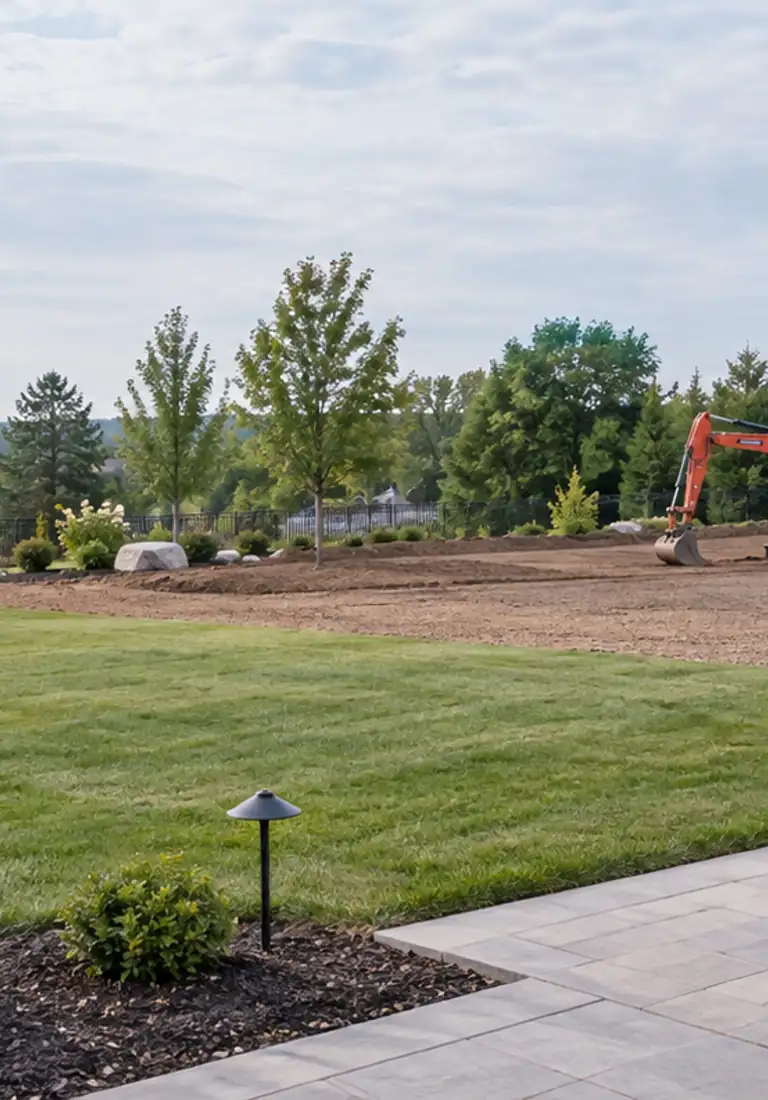

Excavation costs and local soil conditions vary significantly by region. In major markets likeDallas,Houston,Austin, andNashville, complex geological factors like expansive clay, limestone shelf, and ledge rock require specialized compaction protocols to ensure structural integrity for future backyard builds.
Pool Removal Methodologies & Engineering Standards
Understanding the mechanical and structural differences between demolition techniques is critical to planning your backyard reclamation.
Partial Pool Removal (Abandonment & Fill)
Average Price Range: $8,000 – $15,000
The top 18 to 36 inches of the concrete pool wall is demolished. The bottom of the pool shell is fractured with 2-inch minimum drainage holes to prevent hydrostatic water accumulation. Concrete rubble is buried in the bottom, followed by backfilling and compaction of engineered fill.
- Cost Effective: Significantly lower equipment and hauling expenses.
- Speed: Completed in 3 to 5 business days.
- Limitation: Must be disclosed to future home buyers. No heavy load-bearing buildings can be constructed on the site.
Full Pool Removal (Complete Demolition)
Average Price Range: $15,000 – $35,000+
The entire concrete pool shell, steel rebar, electrical components, and plumbing are completely broken down, excavated, and hauled off-site for material recycling. The clean cavity is then backfilled with imported certified soil and compacted in engineered layers.
- Structural Freedom: Restores the land to a virgin-soil state. Safe for future extensions, garages, or ADUs.
- No Disclosures: No long-term impact on property resale values or disclosure requirements.
- Perfect Drainage: Natural subterranean water flow is completely restored.
Compaction Control & Soil Mechanics
Proper backfill compaction is critical to preventing the ground from settling, shifting, or creating dangerous sinkholes. Depending on regional soil profiles—ranging from expansive black clays in the South to sandy loams in the Southwest—we specify strict adherence to ASTM D698 (Standard Proctor) or ASTM D1557 (Modified Proctor) compaction testing. Soils must be placed in 6-to-8-inch lifts, moisture-conditioned, and compacted using heavy vibratory equipment to reach a minimum of 90% to 95% maximum dry density.
Richard M. Beck, PE
Senior Geotechnical Consultant
"Compaction is the single most important phase of pool demolition. Without controlled soil moisture and lift density, long-term foundation settlement is inevitable, especially in heavy clay matrices."
Nationwide Service Coverage & Geological Hubs
Select your region to explore local soil characteristics, municipal permitting guidelines, and certified pool removal contractors.
Southeast HubsActive Hubs
Mid-Atlantic HubsActive Hubs
Midwest HubsActive Hubs
Southwest HubsActive Hubs
Major Service Areas
We connect homeowners with licensed excavation contractors across the United States. Our primary service zones include Dallas, Houston, Fort Worth, Atlanta, Los Angeles, Phoenix, Austin, San Francisco, Indianapolis, and Memphis.